
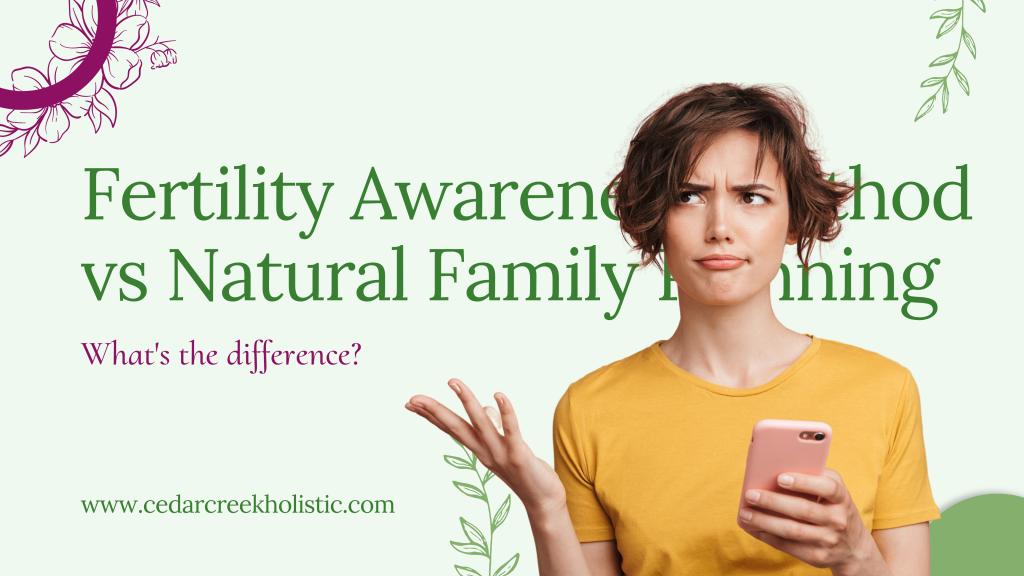
There are many terms used to describe what’s often called cycle charting or fertility charting. The two most common terms are Fertility Awareness Method (FAM) and Natural Family Planning (NFP). While many people have heard of one or the other, there’s often confusion about what they really are and how they differ. I’m here to clear that up!
What is Fertility Awareness?
Fertility awareness is a practice of paying close attention to your body’s natural signs of fertility throughout your menstrual cycle. It’s something you actively do every day by charting key signs like cervical mucus, basal body temperature, and hormonal shifts. This process helps you recognize when you’re fertile and when you’re not, empowering you to make informed decisions about avoiding or achieving pregnancy naturally.
Fertility Awareness Method (FAM) and Natural Family Planning (NFP) are umbrella terms for formal systems that utilize this practice of awareness, offering structured guidelines for using this knowledge to manage fertility.
Several methods of fertility awareness have been developed by medical professionals and scientists over the decades. These methods utilize various signs of fertility, including cervical mucus, basal body temperature, and urinary hormone levels. Some of these signs have been studied as far back as the 1800s, with serious research efforts beginning in the 1930s. However, it wasn’t until around the 1950s that we really started to see the development of what we now recognize as Fertility Awareness Based Methods (FABMs).
Here are some of the formal methods you might hear about:
- Symptothermal methods
These methods involve tracking basal body temperature (BBT) and cervical mucus (CM) to identify the fertile window. The opening of the fertile phase may also be determined using specific calculation rules based on these observations. Examples include Sensiplan, NFPTA, and Couple to Couple League. - Mucus-only methods
These methods focus primarily on charting cervical mucus to determine fertility status. They utilize various techniques to analyze the characteristics of mucus throughout the menstrual cycle. Examples include Billings, Creighton, and Justisse. - Symptohormonal methods
These methods use the ClearBlue Fertility Monitor to track hormonal changes and may combine the monitor with cervical mucus and BBT charting to identify fertile days. Examples include Marquette and Boston Cross Check.
Of the listed methods, some are backed by formal studies, while others rely on unpublished research or are based, albeit somewhat loosely, on findings from formally studied methods.
Each FABM approaches the signs of fertility in unique ways to estimate time of ovulation and fertile days. Most scientifically-backed FABMs have proven to be over 98% effective at preventing pregnancy when used correctly.
Fertility Awareness Method (FAM) vs. Natural Family Planning (NFP)
While Fertility Awareness Method (FAM) and Natural Family Planning (NFP) are often used interchangeably, the only difference is in how the fertile phase is managed, even though both follow the same cycle charting rules. Both methods involve tracking fertility signs to determine fertile and infertile phases.
NFP is rooted in Catholic teachings, which emphasize avoiding all forms of contraception. For this reason, those practicing NFP abstain from intercourse during the fertile phase to prevent pregnancy.
People who follow the same fertility tracking rules but are comfortable using back up methods of birth control, such as condoms or diaphragms, during the fertile phase instead of abstaining tend to prefer the term “Fertility Awareness Method”. FAM is the same practice of cycle charting, without the religious-based restriction against contraception.
FAM gained popularity largely through resources like Taking Charge of Your Fertility by Toni Weschler, which promotes self-teaching and encourages the use of backup birth control methods. However, it’s important to note that this approach lacks the formal research backing and the structure and personalization that comprehensive fertility education offers, potentially leading to misunderstandings and less effective use of the method.
Essentially, the difference between FAM and NFP isn’t how cycles are tracked—it’s about how the fertile window is managed. NFP involves abstinence during fertile days, while FAM users prefer barrier methods on fertile days. So two people could be using the exact same method but the one who practices abstinence refers to it as NFP while the other who is comfortable with use of back up methods on fertile days refers to it as FAM.
It is important to note that abstinence during the fertile phase is considered “correct use” of these methods, as this is how they were tested in the research. Engaging in any kind of intercourse, including with barrier methods or withdrawal, on fertile days is considered “typical use,” which is less effective than perfect use.
What Does Correct Use of Fertility Awareness Mean?
To use fertility awareness correctly, there are two key components. First, you should learn from a qualified fertility awareness educator for at least three full cycles—this is the minimum duration used in studies. For my clients who are committed to long-term use, I recommend a six-month program. This way, they leave feeling confident and equipped to handle any situation.
The second requirement is to follow the established rules of the method. Deviating from these rules shifts you from “correct use” to what we call “typical use.” Correct use, often referred to as “perfect use”, is crucial for those looking to avoid pregnancy.
If you absolutely cannot get pregnant right now, I strongly suggest sticking to correct use. If you’re okay with a lower level of effectiveness and the chance of conceiving, then “typical use” may be a more flexible option for you. Working with a Fertility Awareness Educator can help clarify the differences between correct and typical use, guiding you to the best approach for your unique situation.
As a certified fertility awareness educator, I emphasize the significance of abstinence within the NFP practice. We start by learning this foundational approach, followed by a discussion of your personal intentions and goals. This personalization allows you to understand how specific deviations from the established rules can impact your fertility charting practice and overall effectiveness, empowering you to confidently choose what works best for you and your intentions.
Using Fertility Awareness for Achieving Pregnancy
While Fertility Awareness Based Methods were initially designed for natural pregnancy prevention, they can also be very effective for achieving pregnancy! Learning how to achieve pregnancy with fertility awareness starts with learning how to use it to avoid pregnancy. This helps them recognize their fertile patterns and identify the best times for conception.
Studies show that most couples conceive within six cycles when using fertility awareness for this purpose. After a year of following the correct use of a FABM, couples are more likely to be experiencing fertility issues. The great thing about tracking your cycles with fertility awareness is that you gain valuable insights that you can share with a knowledgeable doctor if you need assistance.
Summarizing Key Terms
Here’s a quick review of the key terms to help you understand the concepts discussed:
Fertility Awareness: Awareness of your body’s natural signs of fertility, including but not limited to basal body temperature, cervical mucus and sensation, cervical position, and urinary hormones like LH and estrogen.
Fertility Awareness-Based Methods (FABMs): An umbrella term describing formally developed methods of fertility management that utilize fertility awareness.
Fertility Awareness Method: A synonym for Fertility Awareness-Based Methods, commonly used to refer to methods taught in self-teaching materials, such as Taking Charge of Your Fertility, or any methods promoting back-up birth control which is considered a deviation from the methods’ original intent.
Natural Family Planning (NFP): Fertility Awareness-Based Methods that require abstinence on days of potential fertility, as the methods were originally designed.
Correct Use: The correct application of Fertility Awareness-Based Methods, which involves abstinence on days of potential fertility, also known as “perfect use.”
Typical Use: Any deviation from the rules of your chosen Fertility Awareness-Based Method, whether knowingly or unknowingly, including using back-up methods of birth control on fertile days or not fully understanding the rules.
Back-Up Methods: Methods such as condoms, diaphragms, spermicide, or withdrawal (also known as “pull out”), often used alongside a Fertility Awareness-Based Method.
Final Thoughts
Fertility awareness offers an incredible opportunity to take control of your reproductive health, whether you’re looking to avoid pregnancy, achieve it, or simply gain a deeper understanding of your body. By understanding the difference between FAM and NFP, along with learning the correct use of these methods, you can confidently navigate your reproductive choices.
Ready to take the next step? Reach out to me today and let’s grow together!
Next: What is a Fertility Awareness Educator?
Questions? Feel free to reach out!

Comments