
In Part 1 of this review, we explored what Tempdrop is, its history, and how it fits into fertility awareness charting. Now, let’s dive deeper into some of the more complex aspects of using Tempdrop. While Tempdrop offers a convenient and innovative way to track basal body temperature (BBT), understanding the nuances of how it works and recognizing potential challenges is key, especially when it comes to interpreting temperature shifts.
In this second part, we’ll examine common issues Tempdrop users may encounter, including false shifts and delayed shifts, and discuss how these challenges can impact the accuracy and reliability of your charts.
Understanding Temperatures: The Basics
In fertility awareness, a rise in basal body temperature—known as a “temperature shift” (or “thermal shift”)—is a key indicator that ovulation has occurred. This shift reflects the hormonal changes that take place after ovulation, specifically the rise in progesterone, which elevates body temperature during the luteal phase (the phase after ovulation).
Each fertility awareness method has its own guidelines for determining what constitutes a valid temperature shift. These guidelines help charters confidently confirm ovulation and identify the luteal phase.
Challenges with Tempdrop and Temperature Shifts
While Tempdrop offers flexibility for tracking BBT, some users encounter challenges that complicate the interpretation of temperature shifts. These challenges can impact how easily or accurately charters identify ovulation using Tempdrop data.
Let’s dive deeper into the two primary types of inaccurate temperature shifts that users may experience with Tempdrop:
1. False Shifts
Over the years, I’ve observed several variations of false shifts on Tempdrop charts. These shifts can make interpreting ovulation patterns challenging, and seem particularly common for individuals with certain hormonal or life circumstances.
- Failed Ovulation Attempts: A small rise in progesterone with ovulation raises temperatures overnight just enough for Tempdrop to detect it. However, the algorithm often keeps the temperatures elevated enough to meet temperature shift rules before they suddenly drop back down, causing uncertainty about the validity of the shift. This is common in women with PCOS or those who are breastfeeding and nearing the return of fertility.
- Full Shifts with No Period: In rare cases, a full temperature shift meets the rules and remains high for what appears to be a full luteal phase, only to drop without a subsequent period. A real shift may occur later. It’s unclear whether this is due to the Tempdrop algorithm or a medical condition like a luteinized unruptured follicle (LUF) but I have seen this more in Tempdrop charts than in oral BBT charts.
- Initial Temperature Rise Adjusted Down: Before the 2022 algorithm change, Tempdrop’s retroactive changes would sometimes adjust down an initial temperature rise, preventing it from meeting the shift rules. Although retroactive changes no longer happen, I have occasionally seen charts with 2 high temperatures that appear to be the beginning of a shift that then drops and doesn’t meet the rules. If ovulation occurs shortly after, these initial high temperatures can sometimes interfere with meeting the rules for a valid shift.
This underscores the importance of working 1:1 with a fertility awareness educator to evaluate your charts accurately and interpret nuances confidently.
2. Delayed Shifts
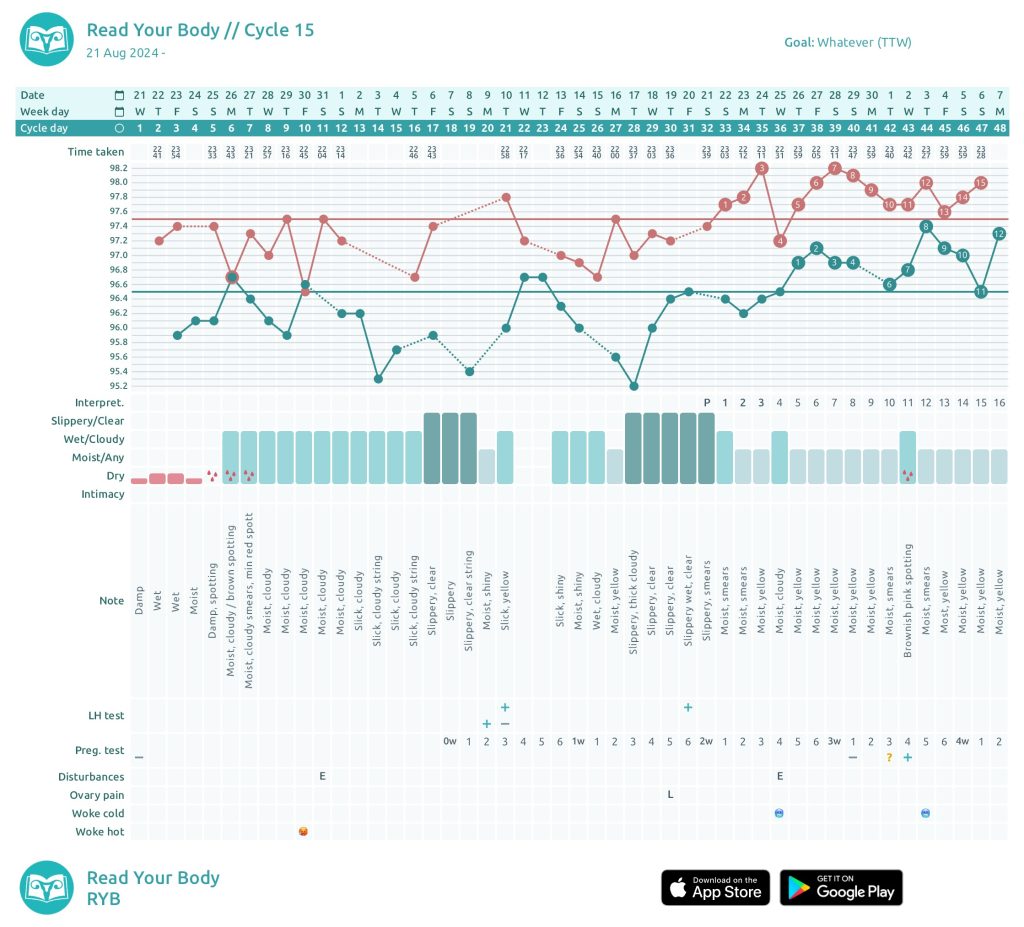
Delayed shifts are much more common than false shifts and seem to occur more frequently with every algorithm update. While it is valid for a temperature shift to begin as late as four days after the mucus peak day, I observe this delay much more often with Tempdrop than with oral BBT.
What’s particularly concerning is when individuals chart both oral BBT and Tempdrop simultaneously, only to find that the delay occurs exclusively with Tempdrop, while oral BBT reliably detects the shift much earlier. This inconsistency raises questions about the algorithm’s handling of temperature data and its ability to accurately identify shifts in a timely manner.
For me, delayed shifts were the most frustrating issue I encountered with Tempdrop. This challenge ultimately led me to stop using Tempdrop as my primary thermometer and return to oral BBT for charting. When the December 2022 algorithm update removed retroactive changes, I was hopeful that this adjustment might reduce the occurrence of delayed shifts.
Unfortunately, this hasn’t been the case. In fact, I’ve observed even more complaints about delayed shifts since the update, making it a persistent concern for many Tempdrop users.
Insights from Boston Cross Check
Boston Cross Check (BCC), an organization that trains and teaches a formal fertility awareness based method, reportedly requested Tempdrop to conduct a comparison of approximately 600 some randomly selected charts, analyzing them using both the original and updated algorithms. For this comparison, thermal shifts were identified according to BCC’s rules, which are notably stricter than those of most other fertility awareness methods. These rules often result in identifying the first and last days of a thermal shift later than other methods.
According to this analysis, no statistically significant difference was found in the first day or completion of thermal shifts between the two algorithms. While these results are promising, it’s important to note that this comparison has not been publicly published, so this information remains hearsay.
The stricter nature of BCC’s thermal shift rules may explain why the results appear more consistent. It’s possible that BCC’s approach aligns better with Tempdrop’s algorithmic quirks, reducing the apparent impact of delayed shifts. However, if the same data were evaluated using a different fertility awareness method with more flexible rules, the outcome might be very different.
Click here for more details on method differences (for those who like the finer points)…
*I have hidden this information/made it optional because it may be overwhelming to beginner charters. If you are familiar with the various formal methods of fertility awareness and the fact that there are many variations in methods and their rules, this information is for you.
Boston Cross Check (BCC) uses stricter thermal shift rules compared to most other fertility awareness methods. In BCC, the coverline is set 0.1°F above the highest of the preceding six temperatures before the temperature rise, and a shift is only confirmed if there are four consecutive temperatures above this line.
In contrast, most other methods set the coverline through the highest of the preceding six temperatures, requiring only three higher temperatures to confirm the shift. Of these, the third temperature must be at least 0.4°F above the coverline. These methods also include exception rules to allow for minor variations, ensuring that ovulation can often still be confirmed even if the standard rules aren’t met.
These differences matter in the context of Tempdrop-associated delayed shifts because BCC’s more conservative rules often result in temperature shifts ending—and sometimes beginning—later than in most other methods. This stricter approach may reduce the impact of Tempdrop’s delayed shifts compared to other methods.
From my professional experience, I’ve observed that the delayed shifts don’t occur across the board. Some individuals experience them rarely, while others encounter them frequently. Unfortunately, there is no way to predict who will experience this issue. This makes it important for users to be aware of the potential for delayed shifts and prepared to assess whether the use of Tempdrop aligns with their charting goals.
Who is Tempdrop Best For—and Who Might Struggle?
From what I’ve observed, Tempdrop works best for individuals with regular cycles of 26-35 days and low to moderately disturbed sleep patterns. These users are the most likely to benefit from Tempdrop’s features without encountering significant issues.
However, individuals with long or irregular cycles (e.g., two or more cycles lasting 36 days or longer in a 12-month period) are more likely to experience challenges with Tempdrop. This includes those with PCOS or breastfeeding mothers, who often face unique hormonal fluctuations that can lead to false or delayed shifts. If you fall into this category, you may find that Tempdrop complicates charting rather than simplifying it.
Understanding your cycle characteristics and Tempdrop’s limitations will help you decide if it’s the right tool for your fertility awareness journey.
The Truth About Tempdrop
As a Fertility Awareness Educator, my first recommendation is to begin with a standard basal body thermometer for charting. The efficacy of fertility awareness methods is rooted in studies that use internally measured basal body temperatures, not skin temperatures like those recorded by Tempdrop. Oral thermometers have been trusted for decades, while wearable skin-based devices like Tempdrop are still relatively new and lack formal studies demonstrating their accuracy or efficacy in fertility charting.
Many people find they can achieve usable charts with oral thermometers, even with an irregular schedule. Strict adherence to guidelines like taking your temperature at the same time every day after at least three hours of sleep isn’t always necessary. If you don’t get a full three hours of sleep or struggle to wake at the same time daily, try charting based on your current schedule for a couple of cycles and see how your patterns develop.
If you find your temperature patterns difficult to interpret, you can consult my Basal Body Temperature Troubleshooting Guide or work with a Fertility Awareness Educator for personalized tips. This might involve adjusting your routine, using a different thermometer, or even switching to vaginal temperature tracking.
Consider Choosing a Method Without Temperatures
It’s a common misconception that fertility charting requires basal body temperature tracking. If Tempdrop doesn’t work well for your cycle characteristics, or if you’re facing persistent challenges with temperature-based methods, don’t hesitate to explore temperature-free fertility awareness options.
These methods are just as effective as symptothermal methods and may be even more suitable for individuals with irregular cycles, postpartum moms, or those with unique challenges.
Billings Ovulation Method®
One of the oldest and most studied fertility awareness methods, the Billings Ovulation Method® focuses primarily on cervical mucus sensation at the vulva. It emphasizes the sensation of mucus as the primary sign, with appearance as a secondary indicator. This method uses stringent, research-backed guidelines supported by nearly 900,000 hormonal assays and numerous studies, making it a reliable and effective option.
Marquette Method
The Marquette Method is taught by health professionals and centers around urinary hormone testing utilizing the ClearBlue Fertility Monitor. It’s a less subjective method, especially ideal for postpartum moms or those with long cycles. While it requires consistent morning urine testing within specific time windows, it also offers optional guidelines for temperature and cervical mucus tracking, making it versatile for users who may want to incorporate additional signs over time.
Both of these methods provide reliable alternatives for charting fertility without the need for temperatures. They can offer higher efficacy than temperature-based methods paired with Tempdrop, especially for those with irregular cycles or sleep disruptions.
But What About Tempdrop?
Tempdrop has developed a bit of a cult following since its release. While some of the hype is justified, it’s important to recognize that it can also be overhyped. The truth is, oral basal body temperature remains the gold standard for temperature-based fertility awareness methods—not Tempdrop. Many people feel compelled to purchase Tempdrop because its popularity makes it seem like the most accurate option. However, a much cheaper oral thermometer works perfectly well for most people.
That said, Tempdrop can be an alternative for individuals who face challenges with oral temperatures. If, after troubleshooting, oral thermometers still aren’t providing usable results, and you’re committed to tracking temperatures, Tempdrop might be worth exploring.
Weighing the Benefits and Drawbacks: Key Limitations
Tempdrop isn’t without its issues. While many users report positive experiences, others encounter problems with the algorithm as outlined above. The extent of these issues is unclear, as the loudest voices often belong to those who have had the worst experiences. Without more comprehensive data, we can’t determine how widespread these problems actually are.
The Boston Cross Check comparison attempts to shed some light on Tempdrop’s performance, but because it evaluates guidelines from only this one organization, its findings serve primarily Boston Cross Check and its users. This still leaves a lot of unanswered questions about Tempdrop’s reliability for the broader fertility awareness community.
Balancing Evidence and Flexibility in Fertility Charting
As an instructor, I prioritize evidence-based education because the efficacy of temperature-based fertility awareness methods is backed by studies using oral thermometers, not wearable devices like Tempdrop. Until Tempdrop undergoes formal testing for accuracy and efficacy, I will continue to recommend standard devices as the foundation of effective fertility awareness.
That said, I recognize that not everyone needs or wants to adhere strictly to the evidence. Individual needs and lifestyles vary, and there’s room for flexibility in how you approach charting. My goal is to empower you with a strong educational foundation so you can make informed decisions that suit your unique situation. Whether you choose oral temperatures, Tempdrop, or even a temperature-free method, understanding the tools and their limitations is key to charting with confidence.
I’ve also recommended Tempdrop to clients who struggled with oral temperature for one reason or another, and in those cases, I’ve seen positive results. For individuals facing challenges with temperatures, Tempdrop can be a helpful tool, as long as its limitations are understood and considered. An informed decision, after exploring all options, ensures that Tempdrop aligns with the individual’s needs.
The bottom line is that about 90% of Tempdrop users I surveyed reported being happy with their experience, even if they faced some of the temperature shift challenges I’ve discussed. If you choose to use Tempdrop, entering the process fully educated will help you interpret your charts accurately and make informed reproductive decisions.
Practical Tips for Success with Tempdrop
To get the best results with Tempdrop, consider these key tips:
- Purchase Insurance and Warranty: For added security, invest in insurance and an extended warranty, including a 12-month satisfaction guarantee. It’s a small expense that provides peace of mind.
- Wear Tempdrop Consistently: Consistency is crucial. Wear it every day, following the manufacturer’s placement guidelines, to avoid inaccurate data and disruptions in your temperature tracking.
- Chart Oral BBT Alongside Tempdrop: For at least three cycles, track both oral BBT and Tempdrop to compare results. This helps identify any issues like false or delayed shifts and ensures accuracy, even with differing temperature patterns.
- Use a Reliable Charting App: Avoid relying solely on the Tempdrop app. Instead, use a flexible charting app like Read Your Body, which syncs with Tempdrop and offers better customization and precision for tracking your fertility data.
My Experience with Tempdrop From A Postpartum Perspective
After posting my original review in 2021, I used Tempdrop sporadically between pregnancies and then consistently again in 2023 after my cycles returned postpartum. I upgraded to Tempdrop 2.0 in April 2024 and used it consistently until conceiving again.
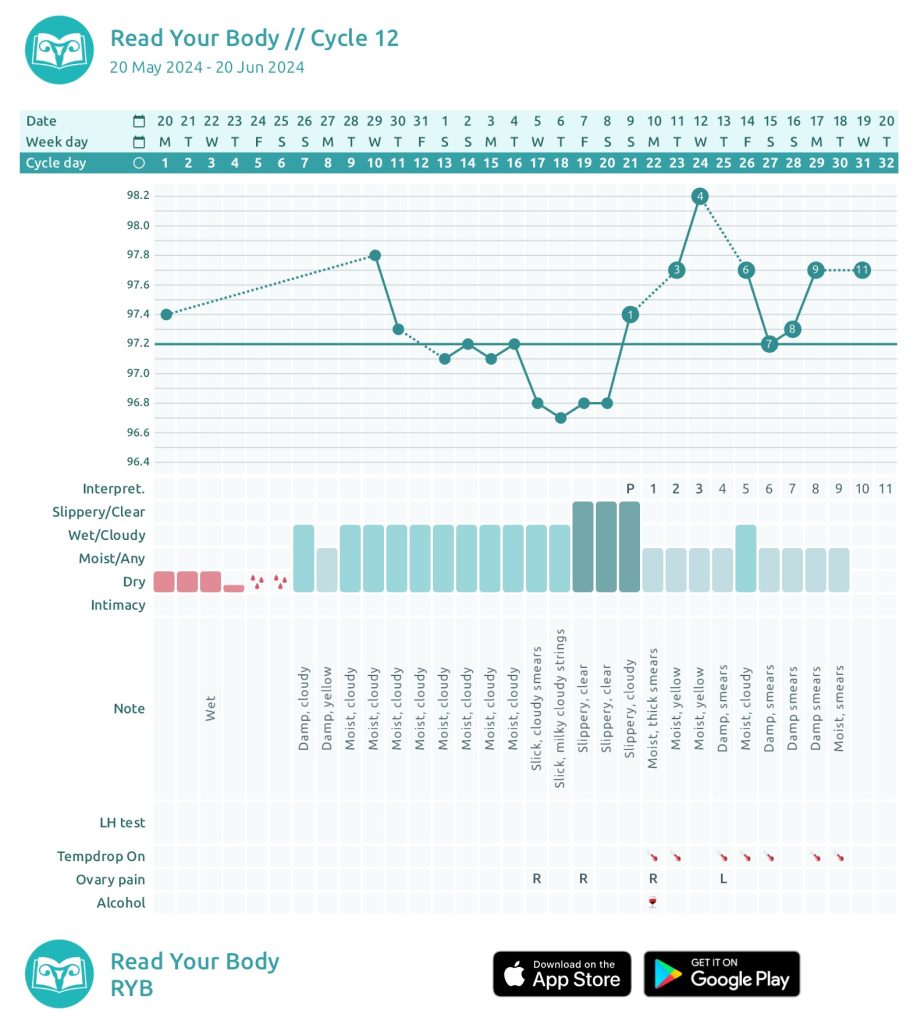
Out of 16 postpartum cycles, I charted 6 with Tempdrop and observed a delayed temperature shift in all but 2 of them. I was only able to chart oral temperatures alongside Tempdrop in 2 cycles: one early in my return to fertility, where oral also showed a delayed shift, and the second (cycle 15) only showed a delayed shift with Tempdrop, not oral—despite my hormones being fairly regulated at that point.
Having PCOS may contribute to the issues I experienced with Tempdrop. My primary method of charting is the Billings Ovulation Method, which allows me to forego temperature charting if I want, as Billings involves a progesterone crosscheck without BBT.
However, I chose to start using Tempdrop again postpartum because my hormones were fluctuating due to poorly managed PCOS, and I wanted added confidence in identifying ovulation. Additionally, with a baby who regularly night-nursed and loved to run off with my thermometer, consistent oral charting became challenging.
Despite delayed shifts with Tempdrop, pairing Billings charting with Tempdrop was a low-pressure way for me to gain confidence in my postpartum body by having a secondary sign for confirming ovulation. And since Billings doesn’t require temperatures I don’t have to feel pressured to make sure I get that temperature everyday.
Is Tempdrop Right for You?
My relationship with Tempdrop remains a mix of love and frustration, but many users report positive experiences, particularly with the improvements in Tempdrop 2.0. This update has made it a more user-friendly tool, especially for those with regular cycles and moderately stable sleep patterns.
Tempdrop offers a convenient way to track temperatures without the rigid requirements of oral BBT, but it’s not a one-size-fits-all solution. It works best for individuals with regular cycles (26-35 days) and stable sleep patterns. If you have an irregular schedule, work varying shifts, are breastfeeding, or have long or irregular cycles, Tempdrop could still work, but you may face additional challenges. Hormonal fluctuations, disrupted sleep, and cycle variability can affect its reliability, especially in confirming ovulation.
Ultimately, determining whether Tempdrop is right for you requires assessing your personal circumstances, charting goals, and willingness to troubleshoot potential challenges. An informed decision, backed by a clear understanding of Tempdrop’s strengths and limitations, will help you decide if it’s the right fit for your fertility journey.
My goal is to provide you with the knowledge and insights needed to navigate these choices confidently and choose the best approach for your fertility journey. Whether you’re troubleshooting oral BBT, deciding if Tempdrop is the right fit, or working through challenges with Tempdrop itself, I can help. I also guide clients in learning a fertility awareness method to interpret their temperatures effectively and confidently. Together, we can find the best tools and strategies to meet your unique needs.
Ready to take the next step? Book a consultation today to get personalized support with your fertility charting, whether you’re troubleshooting oral BBT, exploring Tempdrop, or refining your method. Let’s work together to create a charting system that works for you. Ready to try Tempdrop? You can purchase it here and get an additional 15% off—even on sale prices.
Key Takeaways
- Ideal For:
- Individuals with regular cycles (26-35 days).
- Those with low to moderately disturbed sleep patterns.
- Charters committed to a temperature-based method who have already troubleshooted standard BBT.
- Charters who want a more convenient approach to BBT and are comfortable with Tempdrop’s potential problems.
- Could Work For (But Are More Likely to Experience Challenges):
- Individuals with irregular schedules or shift work.
- Breastfeeding mothers navigating postpartum charting.
- Charters with disrupted sleep patterns (such as frequent night waking).
- Those with long or irregular cycles.
- Challenges:
- May not be ideal for individuals with long or irregular cycles, PCOS, or those breastfeeding, as these factors are more likely to lead to issues like delayed or false shifts.
- Requires consistent and correct use for accurate results.
- Lacks formal studies validating its accuracy and efficacy compared to traditional oral thermometers.
- Recommendations:
- Pair Tempdrop with oral BBT for at least three cycles to compare temperature shift results.
- Use a reliable charting app like Read Your Body instead of relying solely on the Tempdrop app.
- Explore alternative methods like Billings Ovulation Method or Marquette Method if temperatures aren’t working for you.
- Work with a Fertility Awareness Educator like me to troubleshoot oral BBT, decide if Tempdrop is a good fit, and learn how to interpret your temperature data effectively.
Ready to Purchase Tempdrop? Discount Offer
If you decide Tempdrop is a good fit for you, you can save 15% on your purchase by using my exclusive discount code AFHOLISTICFERTILITY at checkout. This code can be applied in addition to any ongoing sales, helping you get the best deal on your Tempdrop. It’s my way of helping to support your fertility journey and making it easier to access this helpful tool at a great value.



Comments