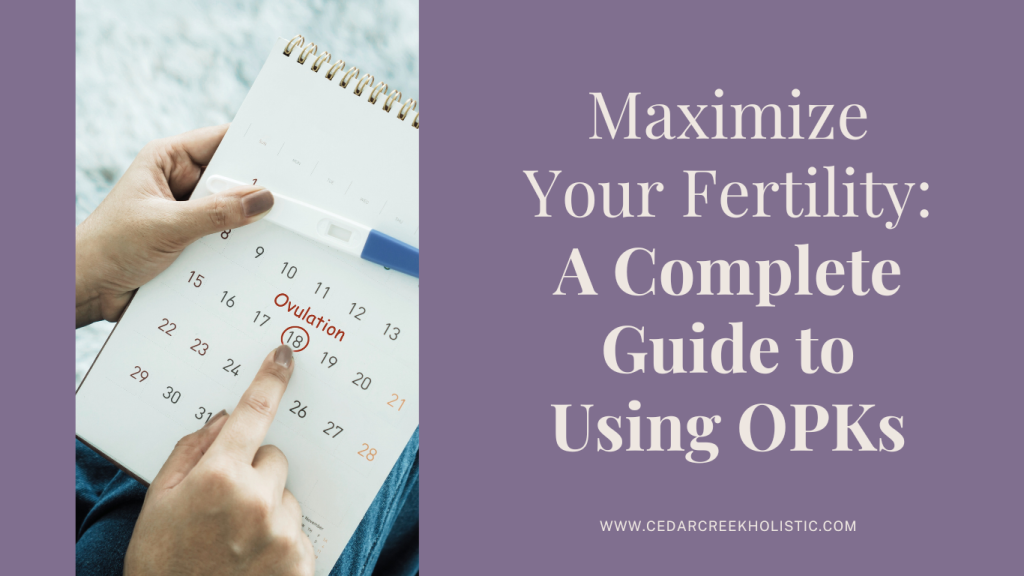
Ovulation predictor kits (OPKs), also known as LH test strips, are one of the most common gateways into fertility tracking, and for good reason! They’re straightforward and easy to use, making them a simple tool for women wanting to understand their cycles.
What are OPKs?
Ovulation predictor kits (OPKs) are also known as LH tests. They work by detecting the presence of LH in urine.
Luteinizing hormone (LH) is a hormone produced by the pituitary gland that plays a vital role in regulating the menstrual cycle and ovulation. In women, an LH surge triggers the release of an egg from the ovary, marking the transition from the follicular phase to ovulation.
How Accurate Are OPKs?
Did you know that OPKs are one of the most studied and most accurate fertility signs? Studies show that they are 96% accurate at predicting ovulation up to 48 hours following a positive.
Are LH Tests Necessary for Effective Fertility Tracking?
Nope! The most effective option is to use a formal, evidence-based method of fertility awareness, learned from a certified fertility awareness educator.
But OPKs are a great starting point for those casually trying to conceive, or for those who want to add a simple cross-check to their fertility awareness practice.
When Should You Use OPKs?
Most women experience a luteinizing hormone (LH) surge in the early morning, and research suggests that this surge can be detected in urine 2 to 6 hours later. For most women, this means the ideal time to test is late morning.
Most OPKs recommend starting on day 10 of your cycle, which works well for women with average cycle lengths. However, if you’re looking to avoid wasting tests, it’s best to time your testing alongside cervical mucus observations. Begin testing when you notice a change in your cervical mucus and increase frequency when your mucus becomes wet and slippery, indicating peak fertility.
How I Optimize LH Testing
Because I use a formal fertility awareness method and am confident in my cervical mucus observations, I wait to test until I experience peak fertile mucus. At that point, I test multiple times a day to catch my surge and track it back to negative.
How to Use OPKs Effectively
Always begin by reading the instructions included with your tests, as they can vary from brand to brand. Generally, it’s best to test a few hours after waking, in the early afternoon, and/or in the evening. You can increase the frequency of testing as the test line darkens or as you notice changes in your cervical mucus.
For optimal results, use a small cup to collect your urine and dip the test strip in it, rather than testing mid-stream. Dipping the strip in a sample for too long or using it mid-stream can cause over-saturation and lead to inaccurate results.
I like to use sample cups with a longer handle for ease of use but you can also get small disposable cups that are great for use out of the house.
How to Read OPK Results
At first, reading LH tests can be a little confusing since they differ from pregnancy tests. Unlike pregnancy tests, LH tests will always show two lines as LH is always present in the body. A positive result occurs when the test line is as dark or darker than the control line. Anything lighter than the control line is considered negative.
When you receive a positive OPK result, ovulation is likely to occur within 36 hours.
Important Considerations
While OPKs are highly accurate, it’s important to remember that they only detect an LH surge, they do not confirm ovulation has actually occurred. Your body may attempt to ovulate, produce a surge in LH, but fail to ovulate successfully. This is more common in women who are postpartum or have PCOS.
To confirm ovulation, you can track a progesterone biomarker, such as Proov PdG test strips, basal body temperature (BBT), or through cervical mucus observations using the Billings Ovulation Method.
Women with premature ovarian insufficiency, early menopause, or those in perimenopause are more likely to experience false positives with OPKs.
OPKs and Fertility Apps
Many women use fertility apps to analyze their OPK results, as these apps often include this feature. However, it’s easy to misuse apps, especially since results can be influenced by the lighting when the LH strip photo is taken.
The only app I recommend for analyzing OPK results is the Premom app, along with their quantitative LH tests. These Premom tests also work well for women with PCOS because they measure a wider range of LH than standard tests. For the most accurate results, test at the same time each day, in consistent lighting, and ideally, rely on your own eye judgment rather than app analysis.
I strongly advise against mixing OPKs from different brands within the same cycle, as each brand has varying testing thresholds.
Recommended OPK Brands
Other top brands I recommend are:
- Wondfo Ultra Accurate Ovulation Test Strips
- easy@Home (Premom) Ovulation Test Strips
- Pregmate Ovulation Test Strips
Who Should Use OPKs?
I most often recommend OPKs for women who are trying to conceive (TTC), as they provide a fairly low-stress way to predict ovulation. However, if you have irregular cycles or want to confirm ovulation, pairing LH testing with a formal fertility awareness method and a progesterone biomarker is highly recommended.
For women trying to avoid pregnancy, LH tests can still be useful. However, these tests should be paired with specific rules, especially for confirming ovulation with a progesterone biomarker. I offer this education as part of my Custom Charting Program.
Maximize Your Fertility Awareness with Expert Guidance
While OPKs are a useful tool for tracking ovulation, they are most effective when combined with a comprehensive fertility awareness practice. Whether you’re trying to conceive, avoid pregnancy, or simply want to understand your cycle better, expert guidance can make all the difference.
I offer personalized fertility charting education through my Custom Charting Program. This program utilizes evidence-based fertility awareness methods, combined in a way that fits your individual needs, to provide a complete view of your fertility.
For those who are trying to conceive (TTC), I also provide fertility doula services, offering support and guidance through your conception journey. As a fertility doula, I help you navigate fertility challenges, provide emotional and practical support, and ensure that you feel empowered every step of the way. Together, we’ll create a tailored plan that combines fertility awareness with holistic care to optimize your chances of conception.
If you’re ready to take control of your reproductive health with professional, personalized support, I’m here to help. Let’s work together to chart your cycle with confidence and clarity.
- Guermandi E, Vegetti W, Bianchi MM, Uglietti A, Ragni G, Crosignani P. Reliability of ovulation tests in infertile women. Obstet Gynecol. 2001 Jan;97(1):92-6. doi: 10.1016/s0029-7844(00)01083-8. PMID: 11152915.
- Roos, J., Johnson, S., Weddell, S., Godehardt, E., Schiffner, J., Freundl, G., & Gnoth, C. (2015). Monitoring the menstrual cycle: Comparison of urinary and serum reproductive hormones referenced to true ovulation. The European Journal of Contraception & Reproductive Health Care, 20(6), 438–450. https://doi.org/10.3109/13625187.2015.1048331
- Moghissi, K, Puscheck, E, et al, Glob. libr. women’s med.,
(ISSN: 1756-2228) 2015; DOI 10.3843/GLOWM.10325


Comments