
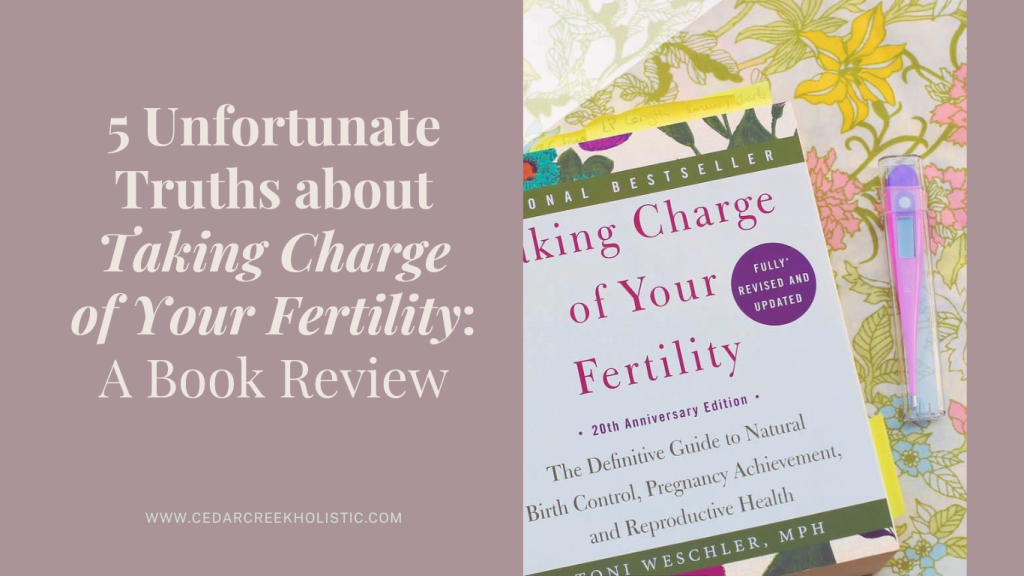
The book Taking Charge of Your Fertility (TCOYF) by Toni Weschler comes up a lot in conversations about fertility, natural methods of family planning and fertility awareness. It’s often the first resource people go to when they’re curious about charting their cycles. And honestly, I get it. It’s empowering, full of detailed information, and has introduced tens of thousands of women to the idea that our cycles are not random or broken, but beautifully designed and highly informative.
I read it myself in 2018 and used the method taught in the book for a year and a half. I even recommended it for years. But I’ve changed my mind.
Here’s why:
Over time, I started to notice gaps and inconsistencies—not just in how the method was explained, but in how it was structured, how the rules were laid out, and how much room there was for misinterpretation. The more I compared it with formal, research-based symptothermal methods and worked with real clients day to day, the more I saw just how confusing and even misleading TCOYF can be for someone trying to use fertility awareness with confidence.
There are a lot of issues scattered throughout the book, too many to cover in a single post, but a handful stand out as especially concerning. These problems don’t just make the method harder to learn; they can also compromise its effectiveness. So, let’s talk about the biggest ones.
1. It’s never been studied
This is one of the biggest red flags for me now that I’ve been teaching Fertility Awareness professionally since 2019: the method outlined in Taking Charge of Your Fertility has never been formally evaluated in peer-reviewed research. That might surprise you since the book frequently quotes effectiveness rates around 98% with perfect use.
But here’s the truth: only one symptothermal method has been formally studied, and that’s the 2007 German study of Sensiplan. In that study, perfect use was found to have an impressive 99.6% effectiveness rate. Weschler herself says in TCOYF that Sensiplan has more stringent pre-ovulatory rules that lead to higher efficacy. The way she discusses this fact has a negative connotation as, in her opinion, it leads to less safe days for those trying to avoid pregnancy.
As a certified instructor who has been teaching for years, I’m not sure that’s entirely true and I think more safe days for lower efficacy is not a great trade-off for those trying to avoid pregnancy.
Since there are a handful of other formal symptothermal methods besides TCOYF—and Sensiplan is the only one with formal studies—I want to touch on efficacy a bit more. I trained with the Natural Family Planning Teachers Association, which is actually where the German organization that developed Sensiplan originated. As a result, many of the rules are identical or similar enough that, theoretically, the efficacy rates of the methods should be very similar.
While I don’t have a lot of personal experience charting with some of the other symptothermal methods, I’ve read the teaching manuals and spoken with certified instructors. Many of these methods also use rules that are very similar to those studied in Sensiplan, especially the double-check rules used in the pre-ovulatory phase to open the fertile window based on historical cycle lengths and timing of ovulation.
Taking Charge of Your Fertility is a single-check method, meaning it primarily uses the presence of cervical mucus to open the fertile window and allows for the use of dry days prior to that. This approach is considered an advanced rule and is taught by some fertility awareness based methods. It is really only effective when working closely with a certified instructor. I’ve seen too many women misinterpret their mucus using TCOYF’s guidelines, and unfortunately, some have ended up with unintended pregnancies because they relied on this dry day rule with no guidance.
If you’re trusting a method to prevent pregnancy, it’s important that it’s grounded in well-established, research-based guidelines—not just popularity. Ultimately, what matters most is choosing a method that aligns with your needs and comfort level, with a clear understanding of how it works and what its limitations might be, especially as it pertains to your own cycles.
2. It’s overly cautious, especially after ovulation
One of the reasons people love Taking Charge of Your Fertility is because it’s so thorough. But in my experience, that thoroughness is also one of its biggest flaws.
The method is designed with self-teaching in mind, so many of the rules for avoiding pregnancy seem to err on the side of caution. While that might sound like a good thing, it actually makes the method more complicated than necessary.
What’s especially confusing is the contrast between the pre-ovulatory and post-ovulatory rules. On one hand, the rules for identifying the start of the fertile window are quite relaxed, as discussed above.
But on the other hand, the rules for closing the fertile window—identifying the end of the fertile time after ovulation—are excessively cautious. There are multiple exceptions to the standard mucus and temperature shift rules, many of which are not found in any formal, research-based symptothermal method.
Even more frustrating? These exceptions aren’t clearly integrated into the main teaching sections of the book. They’re scattered throughout the book, with many of the most important caveats tucked away in the appendix. I’ve talked with plenty of women who didn’t even realize the appendix contained key information, so they missed vital pieces of the method entirely.
If someone does follow all of the rules exactly as written, they may end up unable to confirm ovulation when other methods would have no issue doing so. This leads to extended, unnecessary “unsafe days”. On the flip side, if someone misses extra details hidden in other sections, they may mistakenly believe they’re in the clear when they’re not.
3. The rules are convoluted and hard to internalize
Over the years, I’ve talked with dozens of charters in fertility awareness communities who believed they hadn’t ovulated just because they didn’t meet the specific criteria outlined in TCOYF. Yet with evidence-based methods their charts clearly showed ovulation had occurred.
Others assumed they were following best practices, not realizing that the rules in TCOYF differ quite a bit from those used in researched symptothermal methods. It’s not their fault. The structure of the book simply doesn’t make it easy to learn or retain the method well.
The rules are long, nuanced, and not always presented in a logical or cohesive order. You’ll often find yourself flipping back and forth between sections, trying to figure out whether an exception applies to your chart and in which combination. And many of the clarifications are buried so deep that most people never even see them.
When you’re learning to chart your cycle, you shouldn’t have to decode 500+ pages just to figure out what’s actually safe and what’s not. A solid method should help you build confidence and clarity, not leave you unknowingly missing key details that could impact your success.
4. There are contradictions and a lack of clarity
One of the biggest issues I see with Taking Charge of Your Fertility is its contradictions. There are parts of the book where explanations directly conflict with each other or, at the very least, leave the reader with more questions than answers.
I’ve had charters come to me after reading one part of the book, only to find another section offering a slightly different interpretation. That kind of inconsistency can be incredibly frustrating, especially when you’re learning something as important as fertility awareness. And when it comes to avoiding pregnancy, you can’t afford to be unsure about whether you’re following the method correctly.
A key example is how cervical mucus is described and categorized. The book’s descriptions are sometimes too broad or even contradictory. For example, “creamy” mucus is sometimes labeled as “peak,” and other times wet or watery mucus is considered “peak” but then these descriptions are not consistently reflected in the rules.
Unfortunately, this creates confusion around what exactly counts as peak, which is essential for accurately determining the fertile window. When readers aren’t sure what they’re observing, it’s easy to misinterpret their fertility signs and make decisions based on unclear information.
Another example of this lack of clarity lies in the temperature exception rules we discussed earlier. As we mentioned before, these rules are found in the appendix, which many people miss or overlook. But more importantly, most of these exceptions cannot be combined, and the book doesn’t clearly explain this. One reader reached out to the author directly for clarification, and the response confirmed that combining the temperature exceptions is not recommended.
Additionally, there’s the issue of the cervix observation guidelines. The book introduces the concept of monitoring the cervix but doesn’t provide clear rules on opening and closing the fertile window with this sign. This leaves the cervix as a useful observation, but with no practical application. In contrast, formal, research-backed methods like the one I teach incorporate the cervix into the fertile window interpretation. By observing cervix signs along with mucus and temperature, we can gain even more precise guidance on when the fertile window actually opens and closes, which may increase accuracy and confidence.
This lack of clarity and contradictory advice isn’t just a minor issue, it’s a fundamental flaw. Because key rules are scattered and sometimes conflicting, many people aren’t even aware of what they’ve missed. That can leave you with a false sense of security, or worse, blind spots in your charting. And if you do notice inconsistencies, it quickly turns into doubt, exactly the opposite of the confidence you need when you’re relying on a method to avoid pregnancy.
That’s why I prefer teaching my clients a method with standardized rules and a research-backed framework. It’s easier to learn, easier to trust, and easier to adapt to individual circumstances without second-guessing everything.
My final thoughts
Taking Charge of Your Fertility is a great intro to the world of cycle charting. I can’t deny how important this book has been for spreading awareness. It’s part of my own story, and it’s helped many women conceive by helping them understand their bodies more deeply.
But for those trying to use Fertility Awareness as reliable birth control? I don’t recommend it.
It’s not based on the most current research. It’s not structured enough. And it’s far too easy to get overwhelmed or misinterpret something critical when you’re teaching yourself.
If you’re serious about using Fertility Awareness to avoid pregnancy, I recommend learning a method that’s been studied, vetted, and taught by certified instructors. I teach one of those methods, and I’m here to support you if you want personalized guidance that cuts through the noise and gives you confidence in your charting.
Because your cycle is worth understanding. But even more, you’re worth supporting!
If you’ve made it this far, you might be wondering what to use instead
If you’re someone who prefers to learn independently and isn’t ready or able to work with a certified instructor 1:1, there are other resources I feel comfortable recommending.
One is the Sensiplan handbook, which is the method backed by the 2007 German study I mentioned earlier. It’s thorough, research-based, and offers very clear guidelines. While it’s written in a more technical style and doesn’t offer as many personal stories or illustrations, it’s one of the most trustworthy DIY resources out there.
I also offer a recorded class that walks you through evidence-based symptothermal charting and how to apply the rules properly. It’s designed for beginners as well as seasoned charters, and explains the key fertility signs, how to observe and them, and how to interpret your chart with accuracy and confidence.
That said, I want to be clear: using these resources on your own likely comes with lower efficacy than working one-on-one with a certified instructor. There’s so much value in having someone review your charts, answer your questions in real time, and help you navigate your unique cycle patterns. Especially if you have tricky cycles especially while dealing with postpartum, PCOS, and post-hormonal birth control.
But if you’re someone with fairly regular cycles and you’re okay with taking on a little more of the learning curve yourself, these options can be a great place to start.
And of course, if you ever want more support or an individualized plan, I’m here for that too.



Comments